How to Start a Crochet By Numbers Business

Even though the recession is supposed to be over, the economic recovery is moving at a snail’s pace for many. As a result, more and more women and men are turning their hobbies and crafts into part- and full-time businesses to supplement or even replace income lost as a result of the recession. Crochet is no exception.

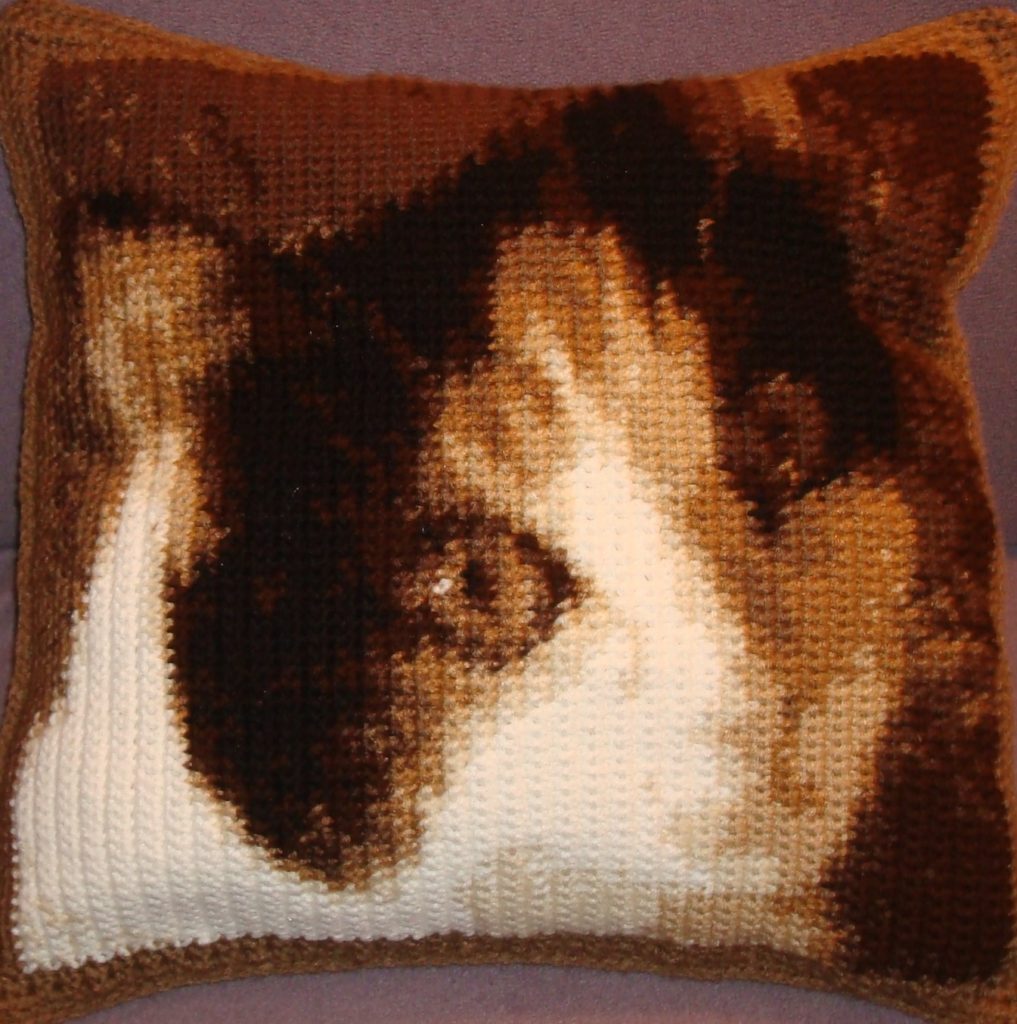
Paul Newman never looked so good!

Paul Newman never looked so good! (Photo used with permission)

One crochet technique that shows incredible business potential is Crochet By Numbers or CBN. Created by Todd Paschall, Crochet By Numbers lets you turn personal photos into beautiful, crocheted works of art like the one illustrated in the photo above.

Todd has developed a process that digitizes photos and then turns them into gray scale and full color patterns that consist entirely of numbers. The photo above is of a piece Todd did of Paul Newman in shades of blue.

CBN Has Great Business Potential

What gives the Crochet By Numbers technique such incredible business potential? First of all, you can earn an excellent income by creating Crochet By Numbers pieces on commission. For your customers, you can create:

  • Framed portraits
  • Wall hangings
  • Pillows
  • Lapghans and throws.

This technique is extremely labor intensive, and you want to be paid well for your time and effort, as well as for the cost of materials.

The smaller (11” x 12”) pieces have sold for as much as $250. A large (25” x 35”) Crochet By Numbers piece can command prices of $500 and up. The cost to learn Crochet By Numbers is $75. Sell one of your pieces for $250, and you’ve paid for your training with money to spare.

My CBN Certification Piece

My CBN Instructor Certification Piece

Secondly, once you have completed the training and mastered the skill, you can become certified to teach Crochet By Numbers both online and offline. You charge your students $75, $50 of which is yours to keep. You pay Todd $25 so that he can create the free pattern for your students that comes with the course.

The total cost to learn CBN and become certified is $150. With just four CBN students, your investment has been returned, and you can start earning $50 per student free and clear.

With my 21 years of experience as an instructional designer and trainer, I’ll provide you with the training and guidance you’ll need to succeed as both an online and offline Crochet By Numbers instructor.

How to Get Started

The first thing you need to do is take the Crochet By Numbers training. In addition to teaching you how to read and execute a CBN pattern, I provide tips and guidance to help you succeed, as well as information on how to:

  • Mount a CBN piece on stretcher bars
  • Line the back of a CBN piece to create wall hangings, afghans and throws
  • Turn your CBN piece into a pillow
  • Competitively price your CBN pieces for sale.

You can stop there and still make money with your CBN pieces, as I’ve outlined above. However, why not go a step further and become a certified CBN instructor? In addition to giving you an extra source of income, you’ll have an opportunity to hone your skill by executing a complex display pattern.

Setting Up Your CBN Business

Of course, with any home-based business, you’ll need to get organized to succeed. This involves, among other things:

  • Getting a business license if your state requires one
  • Setting up a system to track income and expenses
  • Deciding what you’ll focus on (i.e., commissioned pieces, teaching, or both)
  • Setting up space in your home to work on your patterns and store your yarn
  • Marketing your CBN business (I’ll give you some tips on how to do this)
  • Establishing a means of tracking your students’ progress if you decide to teach CBN (I’ll show you how to do this, too).

I can’t think of a more fulfilling way to help supplement your family’s income than with a Crochet By Numbers business. We often think that it’s not possible to make money doing what we love, but if you love to crochet, then a CBN business is definitely a way to turn that dream into reality.

Click HERE to learn how you can get started in this exciting business opportunity.

Adrienne’s Crochet By Numbers Portrait Is Finally Done

It’s been almost two weeks since I last posted. I blame it on doing my taxes and setting up and launching a Facebook page for my blog. Both are done, so I can focus on letting you know what I’ve been up to in crochet land.

Adrienne posing with the Crochet By Numbers portrait I did of her

Adrienne posing with the Crochet By Numbers portrait I did of her

Here is a photo of the Crochet By Numbers portrait of my daughter, Adrienne, that I finally finished a couple of days ago. I was going to frame it on stretcher bars, but now I’m thinking of turning it into a lapghan. If I do the latter, it’s a simple matter of finding some nice, light weight fabric, and hand sewing it to the back. I will probably have to add some more rounds to the border as well.

The second Crochet By Numbers learning pattern I completed

The second Crochet By Numbers learning pattern I completed

Learning Crochet By Numbers and getting instructor certified has been a marvelous journey for me. I won’t lie to you and say it’s been frustration-free. On the contrary, I had to do my second learning pattern (Taurus) and my Obama certification pieces twice because I was making a mistake in how I began and ended rows which put the pattern off by one stitch. A snaggle-tooth President Obama was the result. Ugh!

My CBN Certification Piece

My CBN Certification Piece

At the time, I was pulling out my hair, but looking back, I’m glad my learning unfolded in this manner because I now have a list of tips and useful information that will help my students flow through the training a little more effortlessly than I did.

There are only three prerequisites for learning Crochet By Numbers. You need to : 1) know how to single crochet, 2) know how to a tie knot, and 3) have patience. My online course shows you how to do everything else. Click HERE to find out how to get started.

Adrienne’s Crochet By Numbers Portrait Is Two-Thirds Done

This Crochet By Numbers portrait is about two-thirds comple

This Crochet By Numbers portrait is about two-thirds completed.

I’ve been steadily working on a Crochet By Numbers portrait of my daughter, Adrienne, since the beginning of February. I stated in an earlier post that the photo this pattern is based on was taken the night she graduated from nursing school.

I try to do several rows each night, but I take breaks every now and then to rest or work on other projects. And even though it’s going a little slow, I’m VERY pleased with what I see so far.  This is going to make a fabulous portrait.

If you want to learn how to create similar pieces from photos of your loved ones, check out my Crochet By Numbers online course.

Designing Your Own Custom Crochet Hat

Continuing our celebration of National Crochet Month, this week’s guest post is from crochet designer, Lorrene Eppolite of Cre8tion Crochet. She HAS written a comprehensive blog post that offers detailed information on how to design and customize crochet hats.

When asking my followers what they have the hardest time designing on their own, they almost always answer “hats.”  It’s not just those who are new to crochet either; a lot of veteran crocheters are unable to design their own hat patterns or change existing patterns to fit the size they require.

In this article, I am going to teach you how to design your own crochet hat and how to change any hat pattern to be the size you need.  We are going to focus on women’s hat sizes, but the information can be easily applied to any hat sizing/designing issues.  We will also discuss how you can make your hats more professional looking by hiding any seams and having an invisible finishing edge.

Basic crochet beanie (lower right corner) with variations

Basic crochet beanie (lower right corner) with variations

I will teach you the basics to design your own hat or to customize any hat pattern, and I will work with you to create a hat of your own.   The hat we will be working on will be a basic beanie, though you will have three different options for style.  You can pick from one of the three finishing options in the instructions below.

Once you are comfortable with a basic beanie, you can check out my site  for these other style hats.

How to Determine Hat Size

First, let us discuss how to determine the size hat you will need.  There are some general size dimensions for head sizes by age.   The general measurement for circumference of a woman’s head is 22 inches.  You will design your finished hat to be slightly smaller, approximately 18”.

This measurement won’t be right for everyone; some women have smaller heads and some have larger heads. The hat will stretch if needed but does not need to be stretched to fit either.  If you do not know the head size for whom the hat will be made, you can follow the chart below for approximate head sizes.

Approximate Head Circumference per Age Group

Preemie             10-12”
0-3mo                13-14”
3-6mo                15-16”
6-12mo              17-19”
1-2yo                  18-20”
2-3yo                 19-21”
4-8yo                 20-22”
8+                      21-22”
adult women    22-23”
adult men         23-24”

Now here is where the math comes in.  We all remember that pi = 3.14, right?  Well what does that mean?  Pi is a Greek number or unit of measurement which is the circumference of any circle, divided by its diameter.  It doesn’t have an exact value, but for all practical purposes, you can use the value of 3.14.

You will need to make each hat slightly smaller (3-4”) than the total circumference of the head for whom it is being made.  If you happen to have exact measurements it is great, but if not, you can follow the chart above.

Increasing Rounds Create the “Flat circle”

But how will you know how big to make the hat without making the whole thing, only to realize it is too big or too small?  Well that, my friends, is VERY easy.

Every hat pattern made in the round starts with a certain number of increasing rounds.  These are the rounds where two or more stitches are placed in specific stitches from the previous round.   In order for hats to have a rounded shape the stitches must be increased gradually.

For the best results, I have found that each increase round should increase by the total amount of stitches in the first round.  For example if your first round starts with 10 stitches, then your second round should increase by 10 stitches, giving you a total of 20 stitches.  Your third round should also increase by 10 more stitches, giving you a total of 30 stitches.  (If you begin with 12 stitches your hat should increase this way: 12 > 24> 36, etc.)

I have also found that when starting hats in single crochet, 10 is the optimum number of beginning stitches.  If you start your hat in double crochet, 12 stitches is a great place to start.  If you are using half double crochet, then you can do either 10 or 12, but I prefer to start with 10 stitches.  More advanced stitches such as puff stitches can be done in either 10 or 12, depending on the particular stitch.

The total amount of increasing rounds make up what is referred to as a “flat circle.” This is what you will measure in order to determine the finished hat circumference.  You can be as exact as you want with this measurement.  In order to determine the diameter needed for your flat circle, you will divide the total hat size circumference (approximately 2” smaller than the head circumference) by pi.

EXAMPLE:  My head measures exactly 22”.  So I would design my hat to be 20” in circumference.  In order to determine what my flat circle measurement needs to be I would divide 20 by 3.14 (pi).

20 / 3.14 = 6.369426751592357

Well I am certainly not going to get that close, but I can round that to the nearest, easily obtainable measurement in inches – 6.25”.   I could safely make my flat circle anywhere from 6.0-6.75”, so let’s see how it goes.

In order to simplify this step for you, I have designed the following chart, giving you approximate flat-circle measurements by age group.  I have found many charts that have exact flat-circle measurements, but based on personal experience, the results will be far too large.  I have made hats for every age group, following numerous charts out there and compared them to the actual size required for a good fit.

I have since come up with the following measurements which are what I use.  I get perfect fitting hats every time.  The only time these sizes could be increased would be if you are using an extremely tight stitch or a type of yarn that will not offer much stretch.  Most natural and synthetic fibers have a lot of give.

Approximate Flat Circle Measurement per Age Group

Preemie           2.0-2.75”
0-3mo              2.75-3.50”
3-6mo              3.5-4.25”
6-12mo            4.25-5.0”
1-2yo                4.5-5.25”
2-3yo                4.75-5.50”
4-8yo                5.0-5.75”
8+                     5.50-6.25”
adult women    6.0-6.75”
adult men         6.25-7.0”

Now I would begin to make my hat, using whatever yarn I choose with whatever hook size it recommends.  I would increase in rounds until I reached as close as possible to my desired flat circle measurement. So let’s put all of this theory into practical use:

Basic Crochet Beanie Pattern

I am going to use Red Heart Classic worsted weight yarn, using the recommended hook size of 5.5mm (I).

Preliminary Notes:

All abbreviations and stitches used in the following patterns can be found HERE.

For more information on how to increase rounds gradually, you can read this article.

There are three ways to start a hat in the round. You can either:

  • Make a magic circle/ring, which seems difficult but is really quite easy once you know how.  The magic ring will also give you a much more professional finished look.  You can read this article and  watch this video to learn how to create a magic circle/ring.
  • Or you can use the chain method.  Chain 3-4 (depending on how tight you chain, experiment to see what works best for you) and slip stitch into the first chain to form a ring.  Chain 1 (this will not count as your first stitch) and then place the required amount and type of stitches into the center of the ring.  Join round with slip stitch (into the first stitch you crocheted, not the 1st sc).
  • The other method is to chain 2, and then place the desired amount of stitches in the first chain.  However, it is sometimes difficult to get the required (10-12) stitches into the first chain.

I will be using my method for creating seamless crochet rounds in this pattern.  For more information or if you have any confusion, please read my post on how to make seamless crochet rounds.

Basic Beanie Pattern Instructions

1.  Mc/r (or chain3-4 circle) with 12dc .  Sl st into the back loop only of the 1st dc to join round. (1.75”)

2.  In this round you are going to increase in every st. Ch1.  Skip next st.  2dc into the next st  and in every st around, (leaving one empty st at the beginning of round).  Last 2dc will be stitched into the st previously left empty.   Sl st into the 1st dc to join round.  <24> (3.0”)

3.  In this round you are going to increase in every other st. Ch1.  Skip next st.  2dc in the next st .  *1dc in next st.  2dc in next st.  Repeat from * around (leaving one empty st at beginning of round).  Last dc will be stitched into the st previously left empty.  Sl st into the back loop only of the 1st dc to join round.  <36> (4.25”)

4.  In this round you are going to increase in every 3rd st.Ch1.  Skip next st.  2c in the next st.  *1dc in next st.  1dc in next st.  2dc in next st.  Repeat from * around (leaving one empty st at beginning of round).  Last dc will be stitched into the st previously left empty.  Sl st into the back loop only of the 1st dc to join round.  <48>  (5.5”)

5.  In this round you are going to increase in every 8th st. (this will increase the round by ½ of the amount of stitches previously added per round (6 instead of 12).Ch1.  Skip next st.  2dc in the next st.  *1dc in each of the next 7sts.  2dc in the next st.  Repeat from * around.  Last dc will be stitched into the st previously left empty.  Sl st into the back loop only of the 1st dc to join round.  <54> (6.5”).  Circle won’t be exactly flat at this point since we only increased by 6 stitches in this round, but it will still be where you measure since it is your last increasing round.

This is the measurement exactly in the middle of the guidelines and where I like to ideally fall! Keep in mind that your measurements will probably not be exactly the same as mine, depending on how tight or loose you crochet, but you will want to end up somewhere between 6.25-6.75” at this step.  If you are grossly off you will need to change your hook size.  Go up ½ to one hook size if you are measuring smaller than 6.25” or go down ½ to one hook size if you are measuring larger than 6.75”.

Finishing Options

Decide which design you would prefer to finish with from the choices below.

Option A Finish

beanie_optionA

6.    Ch1.  Skip next st.  1dc into the next st and in every st around.  (leaving one empty st at the beginning of round).  Last 1dc will be stitched into the st previously left empty.   Sl st into the back loop only of the 1st dc to join round.  <54>

7.    Repeat round 7 until you reach your desired height.  I made my hat to 7.5” long, which was achieved with 13 rounds total (including increasing rounds).

8.    1sc into the first st (do not chain or skip any stitches).  1sc in every st around.  Do not sl st to complete round, instead follow my instructions for making seamless crochet rounds.  <54>  Weave in beginning tail.  Embellish hat as you like.  You can find some great flower embellishments in The Flower Repository.

A Note About Hat Length

Here is where we need to discuss length.  There are some guidelines for length but it is really more of a personal preference to decide where the hat will lie when finished.  I do not like my hats to rest too far down my forehead or neck, as I find it distracting.  Optimal length for me is 7.5” long (measured from center/hole to bottom edge of hat.

Some people, however, like their hats to be longer because their hair may be very full, they may not like to where their hats snug, or they may like them to come down low on their forehead or the nape of their neck.

Below are some guidelines for how to decide length of a hat.  For now, we will continue with the pattern which I will make to the length I prefer.  If you would like your hat to be longer, simply add one or two rows as necessary.

General Guidelines for Hat Length by Age Group

Preemie          2.5-3” (I always recommend adding a 1-1.5” brim to preemie hats)
0-3mo             4.0-4.5”
3-6mo              4.5-5.0”
6-12mo            5.0-5.5
1-2yo                5.5-6.0”
2-3yo                6.0-6.5”
4-8yo                6.5-7.0”
8+                     7.0-7.5”
adult women   7.5-8.5”
adult men        8.5-9.5”

If you want to add a fold up brim, add 3 to 4” to total height (1-1.5” for preemie sizes).  If you want to add a floppy/sunhat or cloche style brim subtract 0.5” from the total measurement (not including the brim).

Option B Finish

beanie_optionB

6.    Ch1.  Skip next st.  1dc into the next st and in every st around.  (leaving one empty st at the beginning of round).  Last dc will be stitched into the st previously left empty.   Sl st into the both loops of the 1st dc to join round.  <54>

7.    Ch2 and 2dc into the same space.  *Skip 2sts and 3dc in third st.  Repeat from * around.  Sl st into the top of the ch2 (both loops) to join round. (make sure you are not sl st-ing into the top of the 1st dc).  <18 clusters of 3dc>

8.    Sl st into the next st.  Ch2 and 2dc into the same space.  *Skip 2sts and 3dc in third st.  Repeat from * around.  Sl st into the top of the ch2 (both loops) to join round.  <18 clusters of 3dc or 54dc>

9.    Repeat Round 8 until you reach approx.  ¾” less than desired length is reached.   I made this step to 6.75” long, which was achieved with 6 rows of dc and 6 rows of 3dc clusters.

10.    1sc into the first st (do not chain or skip any stitches).  1sc in every st around.  Sl st into 1st sc to join round.

11.    Repeat round 10. <54>  Do not sl st to complete round; instead follow my instructions for making seamless crochet rounds.  <54>  Weave in beginning tail.  Embellish hat as you like.  You can find some great flower embellishments in The Flower Repository.

12.    Total height 7.5”.

Option C Finish

beanie_optionC

6.  Ch1.  Skip next st.  1dc into the next st and in every st around.  (leaving one empty st at the beginning of round).  Last dc will be stitched into the st previously left empty.   Sl st into the both loops of the 1st dc to join round (change color if desired)  <54>

7.  Ch1.  1ps in same st.  Ch1.  Skip next st.  *1ps in next st.   Ch1.  Skip next st.  Repeat from * around.  Sl st into the top of the 1st ps to join round.

8.  Ch1.  1ps into same space (behind the next ps of the previous round).  Ch1.  *1ps in next space (between ps’ of previous round).  Ch1.  Repeat from * around.  Sl st into the top of the 1st ps to join round.

9.    Repeat round 8 until you reach approx.  ¾” less than desired length is reached.   I made this step to 6.75” long, which was achieved with 6 rows of dc (including increasing rounds) and 8 rounds of ps.

10.    *1sc into the first st.  1sc in next sp.  (do not chain or skip any stitches).   Repeat from * to join round.  Sl st into 1st ps to join round.

11.    1sc in every st around.   Do not sl st to complete round; instead follow my instructions for making seamless crochet rounds.  <54>  Weave in beginning tail.  Embellish hat as you like.  You can find some great flower embellishments in The Flower Repository .

12.    Total height 7.5”

Customization Measurements

How to measure for customized head circumference:
A tape measure is placed on the forehead, above the eyebrows and slightly above the ears,  and passed around the head, ensuring that the widest part of the head is included.

How to measure for customized desired height:
Place a tape measure on your forehead where you want the hat to lay.  Pass tape measure over the back of your head and measure to where you would like the hat to lay on the nape of your neck or back of your head.  Take that total measurement and divide in half.  That is how long you want to make your hat.

Specialty Stitches and Hat Styles

Keep in mind that different stitches will require different dimensions.  You can increase specialty stitches such as a puff stitch, shell stitch, X stitch, etc.

However, the flat circle sizing will be different due to the fact that those stitches are larger and have far more give.  I recommend using a standard stitch in the increasing rounds and to increase 1 to 1.5” smaller than typical for each age group.

Different style hats also require different fits.

  • Slouch hats, for example, do not fall into any of the sizing categories, as they are made to be very loose or very tall.  The band size, however, will follow the measurements more closely.  (To measure circumference using the band simply measure the band at its widest point and double it.  That will give you an approximate circumference).
  • Hipster-style hats are worn shorter but are typically wider.
  • Cloches are tighter at the head to really accentuate that bell shape.

As you design more, you will learn how to modify the size requirements for different styles and stitches.  Do not be afraid to experiment; you can always rip it out and start over … that is how you will learn.

I hope you enjoyed learning how to design your own crochet hat patterns and making your basic beanie.  If you have any questions, please feel free to comment on my blog, Cre8tion Crochet or through email at cre8tion@ymail.com.

Thank you for following along and as always… Happy Hookin’!

LEppolite_3-18-13Lorene Eppolite is an avid crocheter and crafter who blogs about her passions at Cre8tive Crochet.  She is one of those rare individuals who can design and crochet a piece without following a pattern. Luckily for us, she decided to create patterns to go along with her fabulous designs, and they are all free at her site. She also sells her custom designs at her Etsy Shop.

Crochet By Numbers Portrait of My Daughter

Now that I’ve finished my Crochet By Numbers (CBN) instructor certification training, I can focus on doing some patterns based on personal photos, in addition to teaching. I’m crocheting a  CBN portrait of my daughter, Adrienne, based on a photo taken the night she graduated from nursing school.

AJGradPhoto_crpd

In Hawaii, any kind of celebration is always accompanied by bestowing leis on the individual being honored, and I wanted to capture the leis my daughter received that night (the photo is a little blurry because I enlarged it to fit the page).

AJGradPhoto_digital

The original photo included me and my friend standing on either side of Adrienne; I cropped us out to create a “portrait” that a CBN pattern could be based on. This is what the digitized photo that this “brown scale” pattern is based on looks like.

CBN_AJ-1

I’ve completed about 30 of the 105 rows this pattern calls for. And because the piece is 125 stitches long, I used stitch markers to help me count stitches when I need to. I’m just about to start on her face.

I’m trying to take my time, something I recommend that my students do, because rushing only results in mistakes. But I can’t wait to finish it! I’ll post more photos as my work progresses.

Click HERE to find out how you can learn to create beautiful works of art using the Crochet By Numbers technique.